
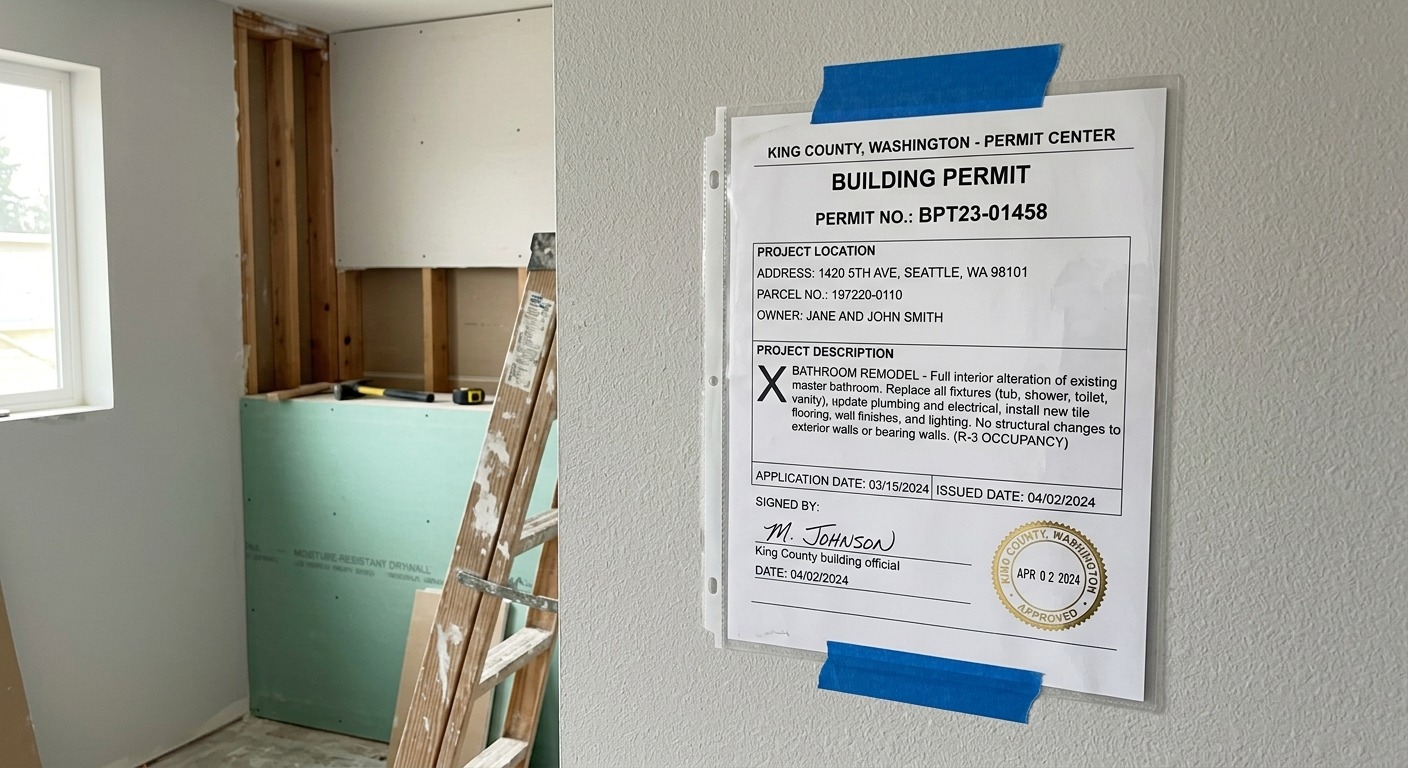
Bathroom Remodel Permits | King County & Eastside Guide
A bathroom remodel may require building, plumbing, electrical or mechanical permits or a combination of them depending on the work and the jurisdiction responsible for the property. Painting and other surface updates are often exempt from a building permit. Moving plumbing, altering electrical circuits, changing ventilation or modifying walls commonly requires approval and inspections.
There is no single permit rule for every home in King County. Properties within Kirkland, Bellevue and Redmond follow their respective city requirements, while King County Permitting serves unincorporated areas. The first step is therefore identifying the authority for the project address and giving that authority a precise scope of work.
Start With the Property’s Permitting Jurisdiction
“Located in King County” does not necessarily mean “permitted by King County.” The county’s permitting department describes its services as applying to unincorporated King County. A home inside an incorporated city usually falls under that city’s building department instead.
Kirkland and Bellevue accept permit applications through MyBuildingPermit, a regional portal used for applications, status tracking and inspection scheduling. Redmond uses its Redmond ePermitting Service, or REPS, for certain over-the-counter permits and its Plan Review Online, or PRO, process for reviewed applications.
Confirm the jurisdiction before relying on a checklist. If it is unclear, use the city or county property lookup or contact the permitting department before demolition begins.
Bathroom Work and the Permits It May Trigger
A permit is not one blanket approval for every part of a remodel. The project may involve separate reviews for the room, its plumbing, its electrical system and its ventilation.
- A building permit generally addresses alterations to the structure or interior configuration, such as moving walls or changing framing.
- A plumbing permit addresses fixtures and changes to water supply, drains and vents.
- An electrical permit addresses new or altered circuits, receptacles, lighting, panels and hard-wired equipment.
- A mechanical permit can apply to exhaust equipment and ductwork.
The likely direction for common bathroom work is summarized below. The final determination belongs to the authority serving the project address.
| Proposed work | Likely permit direction | Important qualification |
| Paint, wallpaper, surface tile or similar finish work | Often no building permit | Associated plumbing, electrical, structural or mechanical work is reviewed separately |
| Replace a toilet or sink in the same location without changing lines | Jurisdiction-dependent | Kirkland and Bellevue publish like-for-like exemptions; Redmond lists new or replacement fixtures on its trade-permit page |
| Replace or install a bathtub or shower | Commonly permit-triggering | Bellevue expressly requires permits for showers and bathtubs; verify the exact scope elsewhere |
| Convert a tub to a shower | Usually one or more permits | Drain, supply, framing, electrical or ventilation changes can affect the required permit set |
| Move a toilet, sink, tub or shower | Plumbing permit expected; others may apply | The work changes water lines, drains or vents |
| Add or move a circuit, receptacle, light or fan wiring | Electrical permit expected | Electrical licensing and permit responsibilities also apply |
| Add or alter exhaust equipment or ducting | Mechanical and/or electrical review may apply | Requirements depend on the equipment, wiring, ductwork and city |
| Add, remove or relocate a wall | Building permit commonly required | Structural changes may require plans or engineering |
| Complete a full gut remodel | Multiple permits are commonly needed | The final set follows the actual plumbing, electrical, ventilation and structural scope |
When a Bathroom Remodel Usually Needs a Permit
A project is more likely to require permits when it changes systems behind finished surfaces. Relocating a toilet can change the drain, vent and water supply. Moving a shower or tub may also involve framing or subfloor work.
Adding a receptacle, installing a circuit, moving lighting or wiring a new exhaust fan can trigger an electrical permit. That work differs from changing a decorative item on an existing approved connection.
Wall changes can require a building permit even when the room’s area stays the same. New partitions, widened openings or modified load paths may need drawings and review.
Ventilation changes may introduce mechanical and electrical requirements when they involve wiring, duct routing or a new exterior termination.
Work That May Not Need a Building Permit
Permit exemptions generally apply to a limited scope, not to an entire project simply labeled “cosmetic.” Kirkland lists painting, papering, tiling, carpeting, cabinets, countertops and similar finish work among its common exemptions. Redmond’s residential exemption handout includes comparable finish work.
Kirkland also identifies like-in-kind replacements such as toilets and sinks in the same location as exempt when gas lines, plumbing lines and electrical circuits are not modified. Bellevue says a permit is not required to replace certain fixtures—such as a wash basin, toilet or bidet—with a similar fixture in the same location. Bellevue treats showers and bathtubs differently and expressly requires permits for them.
An exemption from a building permit does not waive technical-code requirements or a separate trade permit. Adding lighting during an otherwise cosmetic update, for example, can create an electrical-permit requirement even if the paint, tile or cabinetry does not require a building permit.
Tub, Shower and Tub-to-Shower Permit Considerations
Keeping a drain in roughly the same location does not settle whether a tub or shower project needs a permit. The complete scope may include a new valve, modified supply piping, a changed drain connection, opened framing, altered subfloor, new lighting or exhaust work.
Bellevue’s permit guidance is explicit: showers and bathtubs require permits. It separately allows certain like-for-like fixture replacements in the same location, which is why homeowners should not treat all bathroom fixtures as one category.
In Kirkland, the city publishes a broad requirement for changes to building, plumbing, mechanical and electrical systems along with specific exemptions. In Redmond, replacement shower fixtures appear among the city’s examples of work requiring a trade permit. A tub-to-shower conversion in either city should be evaluated from a written scope rather than classified as a simple fixture swap.
A curbless conversion may affect the subfloor and drain geometry in addition to plumbing connections. That does not mean every conversion requires the same drawings or reviews, but it makes an early jurisdiction check particularly important.
Homeowners comparing project scopes can also review the types of bathroom remodeling completed in Kirkland.
Plumbing Permits for Bathroom Remodels
Plumbing permits commonly address the installation, relocation or alteration of fixtures and the pipes serving them. Moving a sink, toilet, shower or tub can change water-supply lines, drains or vents, making the work fundamentally different from replacing a fixture on unchanged connections.
The distinction between new, relocated and like-for-like work matters because the three cities do not describe replacements identically. Kirkland and Bellevue publish exemptions for specified same-location fixtures under stated conditions. Redmond’s electrical, mechanical and plumbing permit page lists new or replacement toilets, sinks and shower fixtures as examples of permitted work.
The application should identify each fixture, whether it stays in place, and whether its water, drain or vent connections change. “Replace bathroom fixtures” is not a sufficiently precise scope.
A plumbing permit should not be confused with approval for structural or electrical work. One bathroom can require multiple permits when several systems change.
Electrical and GFCI Work
Bathroom electrical work is reviewed under the currently adopted electrical code and local amendments. New or altered circuits, moved receptacles, added lighting, service-panel changes and hard-wired exhaust equipment can require an electrical permit. Applicable GFCI protection and wet-location requirements are part of that review.
Exact technical requirements depend on the adopted code, the equipment and the layout. A general online article should not be used to position receptacles, size circuits or choose equipment for a particular bathroom. Those decisions should be made from the current code and the conditions at the property.
Permit responsibility also matters. Washington Labor & Industries states that whoever performs electrical work is responsible for obtaining the permit. A hired electrical contractor must purchase the permit for its work. The administering agency can vary, so not every Eastside electrical permit is purchased directly from the state.
Bathroom Ventilation Requirements
Bathroom ventilation is a code issue, not simply a comfort upgrade. Washington’s current mechanical provisions require local exhaust for bathrooms and toilet rooms. The published minimum is 50 cubic feet per minute for intermittent exhaust or 20 cfm for continuous exhaust. Required exhaust fans must be ducted to the exterior rather than terminating in an attic or another interior space.
The Washington mechanical-code provision also addresses controls, equipment ratings and installed airflow. A fan’s advertised rating does not prove that the completed duct system delivers that airflow; duct configuration and termination affect performance.
Bellevue’s single-family remodel guidance likewise states that exhaust fans vented outside must be provided in remodeled or newly constructed bathrooms at a minimum of 50 cfm. Whether a particular fan replacement requires mechanical, electrical or both types of review depends on what is being changed and the jurisdiction administering the project.
Kirkland Bathroom Permit Rules
The City of Kirkland’s permit guidance states that a permit must be obtained before constructing, enlarging, altering, repairing, moving, demolishing or changing a building or its electrical, mechanical or plumbing system. The city also publishes exemptions that help separate finish-only work from regulated system changes.
Kirkland lists like-in-kind appliance and fixture replacements—using toilets and sinks as examples—as exempt when the replacement remains in the same location and no gas line, plumbing line or electrical circuit is modified. Painting, papering, tiling, carpeting, cabinets, countertops and similar finish work also appear on the exemption list.
Those exemptions do not authorize work that violates technical codes. A finish update can still require permits if it adds a circuit, reroutes a drain, changes exhaust ducting or modifies a wall.
Kirkland directs applicants to MyBuildingPermit when a permit is required. Homeowners planning work through Stonewell Remodel’s Kirkland service area should have the complete scope reviewed before regulated work begins.
Bellevue Bathroom Permit Rules
Bellevue provides unusually specific guidance for bathroom fixtures. The city requires a permit to install a new fixture or move an existing fixture when the work requires installing or modifying water lines, drains or vents. It does not require a permit for certain similar same-location replacements, including wash basins, toilets, bidets and laundry tubs. Showers and bathtubs require permits.
The city also requires a permit for adding or moving electrical circuits and for service-panel changes. An interior remodel that creates new walls can require a building permit even when structural elements are not disturbed.
Bellevue divides permits into those requiring plan review and those that do not. Its permit process overview says qualifying no-plan-review permits are issued the same day they are applied for through MyBuildingPermit. That is not a universal approval timeline for bathroom renovations; the permit path follows the scope and complexity.
Homeowners considering bathroom remodeling in Bellevue should distinguish a same-location toilet replacement from shower, plumbing, electrical, ventilation or wall work before expecting an over-the-counter process.
Redmond Bathroom Permit Rules
Redmond lists alterations and remodels of existing homes under residential building permits. It also treats building and trade permits as separate submittals where applicable, so a remodel involving several systems may produce more than one permit record.
The city’s trade-permit guidance lists new or replacement toilets, sinks and shower fixtures among examples requiring an electrical, mechanical or plumbing permit. New or altered electrical circuits, panels and services are also listed. This is an important difference from the like-for-like language published by Kirkland and Bellevue.
Certain residential electrical, mechanical and plumbing permits can be submitted through REPS as over-the-counter applications. Permit types requiring review are submitted through the city’s PRO portal. Redmond describes two weeks as a typical plan-review time for mechanical, electrical or plumbing permits when plan review is required. It should not be treated as a guaranteed timeline for every bathroom project.
Redmond also requires inspections before permitted work is covered. Applicable trade permits must reach final approval before the final building approval is requested. Stonewell Remodel provides remodeling services in Redmond for homeowners who want the construction and permitting schedule coordinated around one defined scope.
The Permit Application and Inspection Process
The exact forms and inspections vary, but a bathroom-remodel permit process generally follows this sequence:
- Confirm the authority for the address. Determine whether the property is within a city or unincorporated King County.
- Define the complete work. List every fixture, wall, circuit, light, fan, duct and connection that will be added, removed, moved or replaced.
- Identify the required permits. Separate the building scope from plumbing, electrical and mechanical work instead of assuming one application covers everything.
- Prepare the submittal. Depending on the permit, this may include a project description, valuation, fixture counts, floor plans or structural information.
- Apply through the correct portal. Kirkland and Bellevue use MyBuildingPermit. Redmond directs over-the-counter and reviewed applications through its published processes. Unincorporated properties follow King County’s system.
- Wait for issuance before regulated work begins. Approval timing depends on permit type, completeness, corrections and agency workload.
- Keep work visible for rough inspections. Plumbing, wiring, framing and ductwork should not be concealed before the inspections required by the permit.
- Address correction notices. If an inspector identifies a deficiency, correct the documented item and schedule the required follow-up.
- Complete trade finals and the final inspection. Redmond, for example, requires trade permits to be approved and finalized before final building approval.
- Retain the records. Keep the issued permits, approved plans, inspection results and final approvals with the home’s project documents.
A detailed scope reduces the risk of applying for the wrong permit. If work changes during demolition, determine whether revisions or additional permits are required before proceeding.
Who Handles Bathroom Remodel Permits?
The responsible party depends on the permit, the person performing the work and the jurisdiction. A general contractor may coordinate the overall submission and inspection schedule, while a licensed trade contractor may be legally responsible for obtaining the permit covering its own work.
Stonewell Remodel coordinates applicable permit requirements and inspections for qualifying bathroom remodeling projects in King County. Before signing a remodeling agreement, homeowners should confirm in writing:
- Who prepares and submits each application
- Who pays permit and review fees
- Which licensed contractors perform regulated trades
- Who schedules rough and final inspections
- Who responds to corrections
- Who confirms that every permit is closed
Clear responsibility is more useful than a broad promise that a contractor “handles permits.” It identifies the person accountable for each step before work begins.
Frequently Asked Questions
Do I need a permit to replace a toilet or sink in the same location?
It depends on the city and whether any connections change. Kirkland and Bellevue publish exemptions for specified like-for-like fixtures installed in the same location without plumbing-line changes. Redmond lists new or replacement toilets and sinks on its trade-permit page. Confirm the scope with the authority serving the address.
Does a tub-to-shower conversion need a permit?
It commonly requires one or more permits because the project can affect the shower fixture, drain, supply piping, valve, subfloor, wiring or ventilation. Bellevue expressly requires permits for showers and bathtubs. Kirkland and Redmond should evaluate the complete written scope rather than only whether the drain appears to stay in place.
Can I remodel a bathroom without a building permit if I do not move walls?
Possibly, but avoiding wall changes does not eliminate trade permits. Finish work may be exempt from a building permit, while shower replacement, plumbing changes, electrical work or ventilation changes can still require separate approval. The project should be evaluated by its individual components.
Does one bathroom-remodel permit cover plumbing and electrical work?
Not necessarily. Building, plumbing, electrical and mechanical work may require separate applications or permit records. Redmond explicitly lists separate potential submittals for residential projects, and Kirkland’s application materials distinguish building work from regulated trades. Confirm the entire permit set before construction.
When are bathroom remodel inspections performed?
Inspections occur at the stages identified by the issued permits. Rough plumbing, wiring, framing or ductwork generally must remain visible until the required inspection is completed. Applicable corrections and trade finals are handled before final building approval. Follow the permit card and approved plans for the project rather than a geaneric schedule.
How do I know whether my property follows city or King County rules?
Confirm whether the address lies within incorporated city limits. Homes inside Kirkland, Bellevue or Redmond generally follow that city’s permitting department. King County’s permit guidance applies to unincorporated areas. If the address is unclear, contact the relevant jurisdiction before relying on a permit checklist.
Plan Your Bathroom Remodel With the Correct Permit Scope
The work being performed and the jurisdiction serving the property determine which permits a bathroom remodel needs. Defining that scope before demolition makes the construction schedule, trade responsibilities and inspections easier to manage.
Stonewell Remodel serves Kirkland, Bellevue, Redmond and other King County and Eastside communities. Request a bathroom remodel consultation to discuss your space, proposed changes and the permit process that may apply.
Permit requirements and online processes were reviewed in August 2026. Confirm the final permit set with the authority having jurisdiction before regulated work begins.