Bathroom Remodel Cost: Average Prices & What Affects Your Budget
Bathroom remodel cost depends on three things more than any other: how much of the room you change, what you choose to put in it, and what you find behind the walls. A simple refresh can cost a few thousand dollars, while a full gut renovation of a primary bath can reach well into five figures. This guide explains the ranges, why they vary, and how to turn them into a budget for your own project.
Quick answer: The figures in this article are planning estimates drawn from commonly reported industry ranges, not quotes. A cosmetic refresh often falls in the low thousands. A standard remodel commonly lands in the mid-range, roughly $10,000 to $25,000. Full gut renovations and primary bathrooms can run higher. The main cost drivers are layout changes, material grade, labor rates in your area, permits, and hidden damage such as rot or outdated plumbing.
Use the sections below to find the tier that matches your project, check the cost of individual elements, and learn how to request quotes you can compare fairly. Every number here should be confirmed against local contractor bids before you commit.
Average Bathroom Remodel Cost
Published estimates for the average bathroom remodel cost vary because sources define “average” differently. Some count only a standard-size full bath with mid-range finishes, while others blend half baths, primary suites and cosmetic updates together. As a working range, many homeowners spend roughly $6,000 to $25,000 on a typical remodel, with a common midpoint in the low-to-mid teens. Treat these as estimates that shift with region, scope and the year you are pricing.
The table below organizes planning ranges into three levels. They are illustrative and should be verified with local bids.
| Level | Typical estimate | What it usually means |
|---|---|---|
| Low | $3,000–$8,000 | Cosmetic updates, stock vanity, keep layout and fixtures in place |
| Mid | $10,000–$25,000 | Full remodel of a standard bath, new tub or shower, tile, vanity, fixtures |
| High | $25,000–$50,000+ | Gut renovation, layout changes, custom tile and cabinetry, premium fixtures |
Regional variation is significant. Labor and permit costs are generally higher in large metropolitan areas and on the coasts than in smaller markets, and the same project can differ by thousands of dollars between cities. Home age matters too: older houses are more likely to reveal plumbing or wiring that needs updating once walls are opened.
Cost Per Square Foot
Some estimators quote bathroom remodel cost per square foot, and you will often see figures in the range of roughly $100 to $250 or more per square foot depending on scope. Dividing a total budget by the room’s area gives a rough benchmark when comparing similar projects. Labor cost per square foot is sometimes quoted separately, but it varies so widely by trade and region that it is best used only as a loose check against a contractor’s itemized bid.
The method has real limits, especially for small rooms. A 5×7 bathroom is only 35 square feet, yet it still needs a toilet, vanity, tub or shower, plumbing connections, electrical work and ventilation. Those fixed costs do not shrink in proportion to floor area, so small bathrooms tend to cost more per square foot than large ones. Use per-square-foot figures to sanity-check a quote, never to build the budget itself.
Labor vs. Materials: Where the Money Goes
Labor is typically one of the largest line items in a bathroom remodel. Demolition, plumbing, electrical work, waterproofing, tile setting, carpentry and painting all require skilled trades, and in a small room the work is slow and detailed. Many contractors and cost guides describe labor as roughly half of a project’s total, though I cannot cite a single verified split, so ask each contractor to separate labor from materials in the bid.
Materials account for the rest: tile, vanity, countertop, tub or shower base, fixtures, glass, lighting and flooring. This is also where you have the most control. Choosing a stock vanity over a custom one, or porcelain tile over natural stone, can shift the budget substantially without changing the labor involved. Plumbing and electrical labor rise when fixtures move, because new supply lines, drains and circuits are required.
Bathroom Remodel Cost by Scope of Work
Scope is the clearest way to frame a budget, because the same bathroom can cost very different amounts depending on how deep the work goes. It helps to think in three tiers: a cosmetic refresh, a standard remodel and a full gut renovation. Each tier builds on the one before it, and the jump between them is mostly driven by whether walls, floors and plumbing are opened up.
A note on terminology: “remodel” usually means changing the design, layout or function of a space, while “renovation” often means restoring or updating what is already there. In practice, contractors and homeowners use the words interchangeably, and pricing guides treat bathroom remodel and bathroom renovation costs as the same thing. What matters is the written scope in your quote.
| Tier | What it includes | Estimated range |
|---|---|---|
| Cosmetic refresh | Paint, new faucet and hardware, mirror, lighting, regrouting, possibly a new vanity top or toilet | $1,000–$6,000 |
| Standard remodel | New vanity, toilet, flooring, tub or shower surround, tile, fixtures; layout stays the same | $10,000–$25,000 |
| Full gut renovation | Everything removed to the studs; new plumbing, wiring, waterproofing, layout changes, premium finishes | $25,000–$50,000+ |
A cosmetic refresh, sometimes called a bathroom makeover, suits a room whose bones are sound. You change what people see and touch without disturbing plumbing or walls, so costs stay low and the work can finish in days. A partial remodel sits between refresh and standard, such as replacing only the shower or only the vanity and floor. Partial projects can be a smart way to spread spending over time, though doing trades in separate phases may cost more in total than a single coordinated job.
A standard remodel replaces most visible elements while keeping fixtures roughly where they are. A full gut renovation is the most expensive because it exposes everything: subfloor, framing, supply lines and wiring. It is also the best time to fix hidden problems and to move a toilet, widen a shower or add storage. These ranges are estimates; local quotes will set the real figure.
Bathroom Remodel Cost by Bathroom Type and Size
Bathroom type and size shape the budget because they determine how many fixtures you buy, how much surface needs tile, and how much plumbing work is involved. A powder room with a toilet and sink is a very different project from a primary suite with a double vanity, freestanding tub and walk-in shower.
The size examples below are rough planning ranges for a mid-range remodel. They assume no layout changes and no major hidden damage, and they will vary by region and finish level.
| Dimensions | Typical use | Estimated mid-range remodel |
|---|---|---|
| 5×7 ft | Standard small full bath | $8,000–$18,000 |
| 5×10 ft | Medium full bath | $10,000–$22,000 |
| 10×10 ft | Large or primary bath | $18,000–$40,000 |
Half Bath or Powder Room
A half bath or powder room contains a toilet and sink but no shower or tub, so it is the least expensive room to redo. A typical powder room remodel cost might run roughly $2,000 to $10,000, depending on whether you simply swap fixtures or add new flooring, wallpaper, a custom vanity and fresh lighting.
Because there is no wet area to waterproof, spending goes mainly toward the vanity, toilet, flooring and finishes. Powder rooms are visible to guests, so many homeowners splurge here on a statement mirror, wall treatment or designer faucet while keeping the total modest.
Small or Guest Bathroom
A small bathroom remodel cost commonly falls between about $6,000 and $15,000 for a mid-range job, with a 5×7 room often priced in that band. Guest bathroom remodel cost is similar, though guest baths are sometimes redone with simpler finishes since they see lighter use. Budget versions can come in lower when the layout stays and fixtures are stock.
In small spaces, money goes mostly to the tub or shower, tile, waterproofing and labor, because access is tight and every trade must work around the others. A shower versus tub choice matters: converting a tub to a walk-in shower typically costs more than a straightforward tub replacement because it involves new drains, waterproofing and often more tile, but it can make a tiny room feel larger. If the bath is the only tub in the home, consider resale expectations before removing it.
Master or Primary Bathroom
Master bathroom remodel cost usually ranges from roughly $15,000 to $40,000 or more, since primary baths are larger and carry more features. The average master bathroom remodel cost reported across sources varies widely, which reflects how different these projects can be.
Features that push the budget up include double vanities, freestanding tubs, large curbless showers with glass enclosures, heated floors, custom cabinetry, natural stone and layout changes. The spend is easiest to justify when the room is used daily, when the current layout is dysfunctional, or when you plan to stay in the home long enough to enjoy the upgrade.
Adding a New Bathroom
Bathroom addition cost is a separate project from a remodel. You are creating new space or converting existing space, which can require framing, new plumbing runs, electrical circuits, ventilation, insulation and finishes. Estimates commonly start in the tens of thousands, often roughly $20,000 to $50,000 or more, depending on size and whether you add onto the house or convert a closet or bedroom corner.
The biggest variables are the distance to existing plumbing stacks and drains, since longer runs cost more, and permit requirements. Adding a bathroom nearly always requires permits and inspections. Get a plumber’s assessment early, because location relative to existing lines can swing the total considerably.
What Affects Bathroom Remodel Cost
Several factors determine where your project lands within a range. Some, like room size and finish choices, are decisions you control. Others, like local labor rates and hidden damage, are not. Understanding each helps you spot where a quote is reasonable and where you have room to adjust.
The most useful habit is to separate “must do” costs, such as repairing water damage or bringing wiring up to code, from “want” costs, such as upgraded tile. That separation lets you protect the essentials if the budget tightens. The following factors are the major ones to review.
Size and Layout Changes
Larger rooms need more flooring, tile, paint and often more fixtures, but layout changes usually matter more than square footage. Moving a toilet, shower or sink means rerouting drains and supply lines, and drain slope requirements can force work below the floor. Relocating fixtures can add thousands of dollars compared with replacing them in place.
Structural changes such as removing a wall, enlarging a window or cutting into floor joists add engineering, framing and permit costs. Ventilation is another often-overlooked item: a vent fan that is properly sized and ducted to the exterior protects the finished room from moisture, and adding or relocating one can involve electrical and ductwork labor.
Materials and Finish Level
Finish level is the biggest discretionary factor. Prefabricated units, stock vanities and standard tile cost far less than custom-built cabinets, natural stone or specialty glass. Custom work also adds lead time and labor, since non-standard dimensions require fabrication and careful installation.
- Budget: stock vanity, ceramic or vinyl flooring, acrylic tub or shower surround, basic fixtures.
- Mid-range: semi-custom vanity, porcelain tile, quality fixtures, a tiled shower with glass door.
- High-end: custom cabinetry, natural stone, frameless glass, premium fixtures, heated floors and a luxury bathroom remodel cost that can climb steeply.
Labor, Location and Contractor Pricing
Labor rates vary by region, trade and demand. Urban and high-cost areas generally charge more, and busy seasons can raise prices or lengthen schedules. Licensed plumbers and electricians typically bill at higher rates than general laborers, and a project that needs several trades pays for coordination as well.
Contractor quotes also differ in what they include, so compare line by line. A lower bid may exclude demolition, permits, disposal or an allowance for fixtures. When you contact bathroom remodel contractors, request the same scope from each so the numbers are truly comparable.
Permits, Demolition and Hidden Problems
Permits are commonly required when you move plumbing, alter electrical circuits or change structure; fees and rules vary by jurisdiction, so check with your local building department. Demolition and haul-away are part of nearly every remodel, and a full gut costs more than removing a few fixtures.
Hidden problems are the main source of budget overruns. Once walls and floors are opened, contractors may find water damage, rot, mold, corroded or outdated plumbing, or old wiring that does not meet code. These must be fixed before new finishes go in. A sensible tip is to hold a contingency of about 10% to 20% of the project budget for surprises, with the higher end for older homes.
Cost of Common Bathroom Remodel Elements
Breaking a project into individual elements makes it easier to build a realistic budget and decide where to economize. The table below gives typical installed-cost ranges as estimates only. Actual prices depend on product grade, local labor and the condition of your existing bathroom.
| Element | Estimated range | Main cost drivers |
|---|---|---|
| Vanity with sink | $500–$4,000+ | Size, single or double, stock or custom, top material |
| Toilet (installed) | $250–$900 | Standard vs. wall-hung or smart models |
| Flooring | $800–$3,500 | Material, subfloor repair, heated systems |
| Wall and shower tile | $1,500–$7,000 | Tile type, pattern, area covered, labor |
| Shower door | $400–$2,500 | Framed vs. frameless, custom sizing |
| Lighting | $150–$1,000 | Fixture type, new wiring needs |
| Ventilation fan | $200–$800 | Fan quality, ducting, new electrical run |
Ranges overlap and add up quickly, so choose a few places to spend and keep the rest simple. The shower or tub area typically takes the largest share, followed by the vanity and tile work.
Cost drivers repeat across items: labor complexity, access, and whether the old element must be removed and the surface repaired. For example, a new toilet in the same location is inexpensive to install, while relocating it adds plumbing labor. Ventilation and lighting are small line items that are easy to skip but protect the room and its finishes over time.
Shower and Tub Remodel Costs
Shower remodel cost varies with the approach. A prefabricated acrylic or fiberglass shower insert is the budget route, while a custom tiled shower costs more due to tile, waterproofing and labor. Walk-in shower remodel cost rises with glass, benches, niches and curbless designs that require floor modifications.
| Project | Estimated range |
|---|---|
| Tub replacement (same location) | $2,000–$6,000 |
| Prefab shower insert | $2,000–$6,000 |
| Tub-to-shower conversion | $3,000–$10,000 |
| Custom tiled walk-in shower | $5,000–$15,000+ |
One-day or express remodel services exist, typically using prefabricated acrylic wall systems and bases that install quickly. They can reduce disruption and are often priced in the low-to-mid thousands, but design options are narrower and prices vary by company. Prefab suits those who want speed and low maintenance; tile suits those who want custom looks and are willing to pay for longer installation.
Bathtub-to-shower conversions cost more than they may appear because of new drains, framing adjustments and waterproofing. If you want a tub replacement without changing the footprint, the cost is lower, particularly if the plumbing stays put.
Vanity, Fixtures, Tile and Finishing Costs
Vanities range from inexpensive stock cabinets to custom double units. Prefabricated vanities with a top included are a common way to save, while custom pieces and stone tops raise costs. Faucets, shower valves and trim vary widely; a mid-range set looks good without premium pricing, though the valve behind the wall deserves quality because replacing it later is costly.
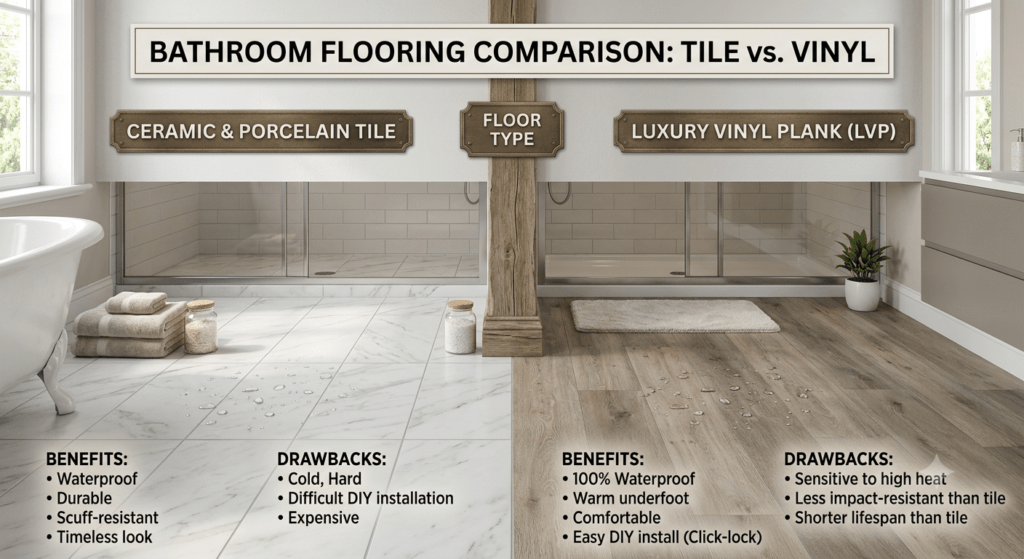
- Flooring: vinyl and ceramic are budget-friendly, porcelain is a durable mid-range choice, and heated floors add cost.
- Wall tile: standard rectangles are affordable; mosaics, large-format slabs and natural stone raise labor and material costs.
- Mirrors and lighting: basic mirrors are inexpensive, while custom mirrors and layered lighting cost more but change the room’s feel.
Finishing details such as paint, trim, towel bars and accessories seem minor but add up. Plan an allowance for them so the last items do not strain the budget.
DIY vs. Hiring a Professional
Doing part of the work yourself is the most direct way to cut labor costs, which can represent a large share of the total. DIY bathroom remodel cost savings are real for tasks like painting, demolition, installing accessories, replacing a faucet or swapping a vanity. These jobs need modest tools and carry limited risk if done carefully.
The risks grow with complexity. Waterproofing errors can cause leaks that damage framing and ceilings below, and the damage may not show for months. Mistakes in tile setting, drain slope or electrical connections can be expensive to correct and may violate code. Time is also a cost: a bathroom is often the only one in the house, and an inexperienced DIY schedule can stretch for weeks.
Hire licensed plumbers and electricians for relocating fixtures, running new circuits, working on the main supply or drains, and anything that requires a permit. A good compromise is to do demolition and painting yourself while hiring pros for waterproofing, tile, plumbing and electrical. Check that any contractor is licensed and insured as required locally, and confirm who pulls permits.
How to Budget and Get an Accurate Estimate
A reliable bathroom remodel budget starts with a clear scope, not a total number. Decide what you want to change, which items are essential, and where you can compromise. Then gather real quotes to replace the rough ranges in this article with local prices.
- Define the scope. List what stays, what goes and what is new. Note layout changes, since they drive plumbing costs.
- Research ranges. Use the tiers above to set a realistic target for your bathroom type and size.
- Get several quotes. Request at least three itemized bids for the same scope, from licensed contractors with references.
- Compare line by line. Check what is included: demolition, permits, disposal, fixture allowances, waterproofing and warranty terms. A low bid with large allowances may cost more later.
- Add a contingency. Set aside roughly 10% to 20% for hidden issues and changes.
- Plan financing. Options include savings, a home equity loan or line of credit, a personal loan or contractor financing. Compare interest rates, fees and repayment terms before choosing.
- Get everything in writing. A contract should state scope, payment schedule, timeline and change-order procedures.
Be cautious of bids far below the others, which can signal missing scope, unlicensed work or later change orders. Ask how unexpected conditions will be priced before work begins.
How to Lower Your Bathroom Remodel Cost
A low cost bathroom remodel is possible without making the room look cheap. The key is knowing which decisions save the most money and which shortcuts cost more later. These strategies apply to both budget bathroom renovation and larger projects.
- Keep the existing layout. Leaving the toilet, tub and sink where they are avoids rerouting plumbing, often the biggest savings.
- Choose prefab or stock items. Prefabricated vanities and shower inserts cost less than custom work and install faster.
- Reface instead of replace. Refinishing a tub, regrouting tile or painting cabinets can refresh a room for far less.
- Do some work yourself. Demolition, painting and simple installations reduce labor charges.
- Phase the work. Spread projects over time if cash flow is tight, understanding that separate mobilizations can add some cost.
- Shop smart. Compare retailers, watch for sales and order early to avoid rush charges.
- Splurge selectively. Spend on what you touch daily and what is hard to replace, like the shower valve and waterproofing; save on accessories, mirrors and paint.
Avoid cutting corners on waterproofing, ventilation and plumbing quality. Those failures cost far more to repair than the savings they generate.
Is a Bathroom Remodel Worth the Cost?
Whether a remodel pays off depends on your goals. If you plan to sell soon, an outdated or damaged bathroom can hurt buyer impressions, and a measured update often makes sense. Return on investment figures are published by various industry sources, but they change from year to year and by market, so check current local data rather than relying on a single percentage.
A remodel is easiest to justify when it fixes a real problem, such as leaks, poor ventilation, safety concerns or a layout that does not work. It also makes sense when you will live in the home for years and use the room daily. Comfort, accessibility and reduced maintenance are legitimate returns even when they do not show up in a sale price.
It is harder to justify when you overbuild for the neighborhood. Luxury finishes in a modest home rarely recoup their cost at resale. If your bathroom is functional and clean, a cosmetic refresh may deliver most of the visual benefit for a fraction of the price. Set priorities: fix defects first, improve function second, and add luxury last.
How Long Does a Bathroom Remodel Take?
Timeline depends on scope. A cosmetic refresh can take a few days to a week. A one-day remodel using prefab components may be completed in a single day in the right conditions, though preparation and ordering occur beforehand. A standard remodel often takes about two to four weeks, while a full gut or primary bath can take four to eight weeks or longer.
Delays usually come from permits, product lead times, hidden damage and trade scheduling. Custom vanities, glass and specialty tile can take weeks to arrive, so order early. Because many projects follow a similar sequence, the stages below show how the work generally unfolds.
- Planning and design: scope, selections and quotes, often one to several weeks.
- Permits and ordering: approval times and material lead times vary by location.
- Demolition: typically one to three days.
- Rough-in: plumbing, electrical and framing, followed by inspections where required.
- Waterproofing and surfaces: walls, shower pan, tile and curing time.
- Fixtures and finishes: vanity, toilet, glass, lighting, paint and final inspection.
Frequently Asked Questions
What is the average cost of a bathroom remodel?
Estimates vary by source, but many homeowners spend roughly $10,000 to $25,000 on a standard remodel. Cosmetic updates cost less, and gut renovations or primary baths can cost more. Local quotes give the most reliable figure.
What is the most expensive part of a bathroom remodel?
Labor is often the largest overall expense, and the shower or tub area is usually the costliest portion of the room. Layout changes that move plumbing can also be a major cost.
How much does a small bathroom remodel cost?
A small bathroom often costs about $6,000 to $15,000 for a mid-range job, with lower totals for budget updates. Small rooms cost more per square foot because they still need the same fixtures and trades.
Do I need a permit to remodel a bathroom?
Permits are commonly required for plumbing, electrical or structural changes, and sometimes not for cosmetic work. Rules differ by location, so confirm with your local building department.
How do I plan a bathroom remodel?
Define your scope, set a budget with a contingency, gather itemized quotes and order long-lead items early. Settle design choices before demolition to avoid costly changes mid-project.
How can I find the cost of a bathroom remodel near me?
Request itemized quotes from several licensed local contractors for the same scope. Regional labor rates and permit fees make local bids more accurate than national averages.